Explore our projects, publications, and analysis in the Resource Hub.
← Back to Publications
Report 2019

Carbon Free Boston: Social Equity Report

An examination of how Boston’s climate strategies could reduce inequities in housing, transportation, and waste.

Atyia Martin, D'Janapha Fortune, Sam LaTronica, Elizabeth A. Stanton, Bryndis Woods, Eliandro Tavares, Tanya Stasio, Ricardo Lopez, Sagal Alisalad, Myisha Majumder, Namgay Tshering, Cutler J. Cleveland, Peter Fox-Penner, Michael J. Walsh, Margaret Cherne-Hendrick, Sucharita Gopal, Joshua R. Castigliego, Taylor Perez, Adam Pollack, Kevin Zheng, Emma Galante

Boston University Institute for Sustainable Energy, All Aces, Applied Economics Clinic
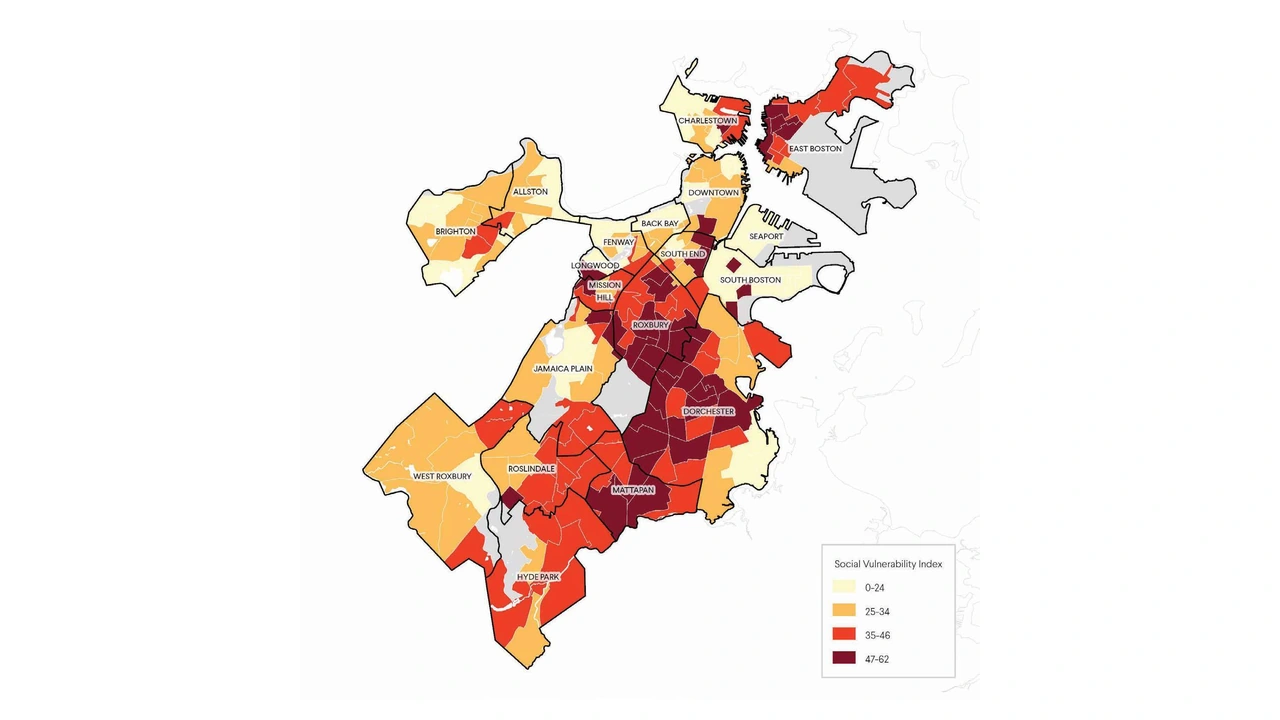
Boston map showing the report’s social vulnerability index and original legend.Expand figure
Boston map showing the report’s social vulnerability index and original legend.

Carbon Free Boston Social Equity Report, Figure 2: social vulnerability index. Calculations by Applied Economics Clinic; historical study data.

Open original image
Carbon Free Boston Social Equity Report, Figure 2: social vulnerability index. Calculations by Applied Economics Clinic; historical study data.

This report examines how Boston’s transition to carbon neutrality could improve conditions for residents who face high energy burdens, inadequate transportation, and environmental harm. It considers housing efficiency and affordability, access to cleaner transportation, and the distribution of waste-related burdens and employment opportunities.

All Aces, the Applied Economics Clinic, and Boston University’s Institute for Sustainable Energy contributed to the report. Its recommendations make equity an explicit part of selecting and implementing climate strategies.